

A Spanish Cable Car Over the Whirlpool, Since 1916
Contents4 sections
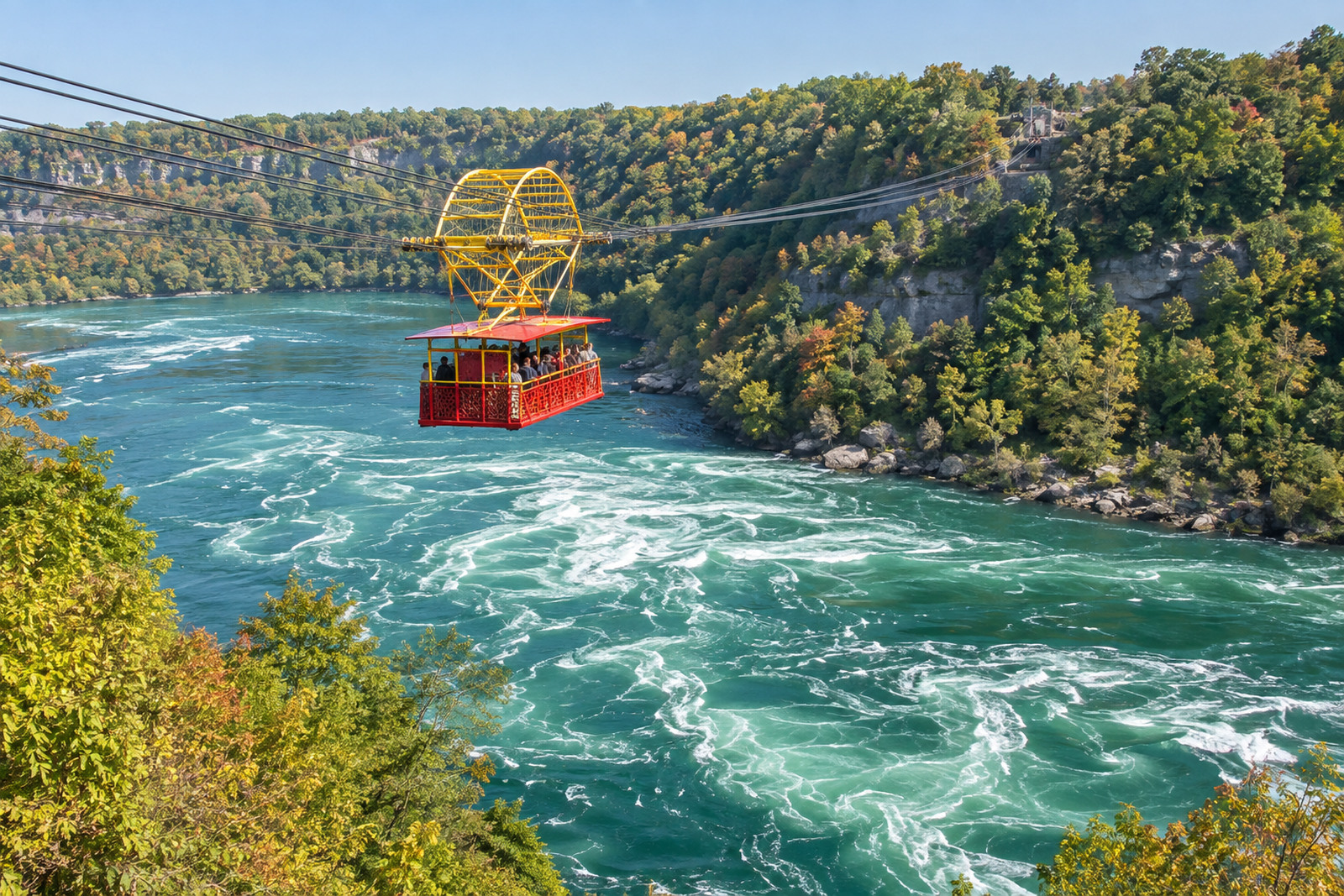
The Aero Car pulls out from the Canadian bank on a single cable slung more than 500 metres across the gorge, and by the time it reaches the far tower it has crossed the international border four times. The cabin holds up to 40 passengers and clears the water by about 76 metres, directly over the Niagara Whirlpool.
Below the car, the river does something it does nowhere else on this stretch: it turns. The Whirlpool is not a lake and not a bend in the ordinary sense. It formed about 4,200 years ago, when the retreating falls cut across the old, buried gorge of St. David's, a channel left over from an earlier glaciation that ran almost at right angles to the modern river. Water pours in from Niagara's main channel, spins against the walls of that ancient cut, and spills out again downstream toward Lewiston and Queenston.
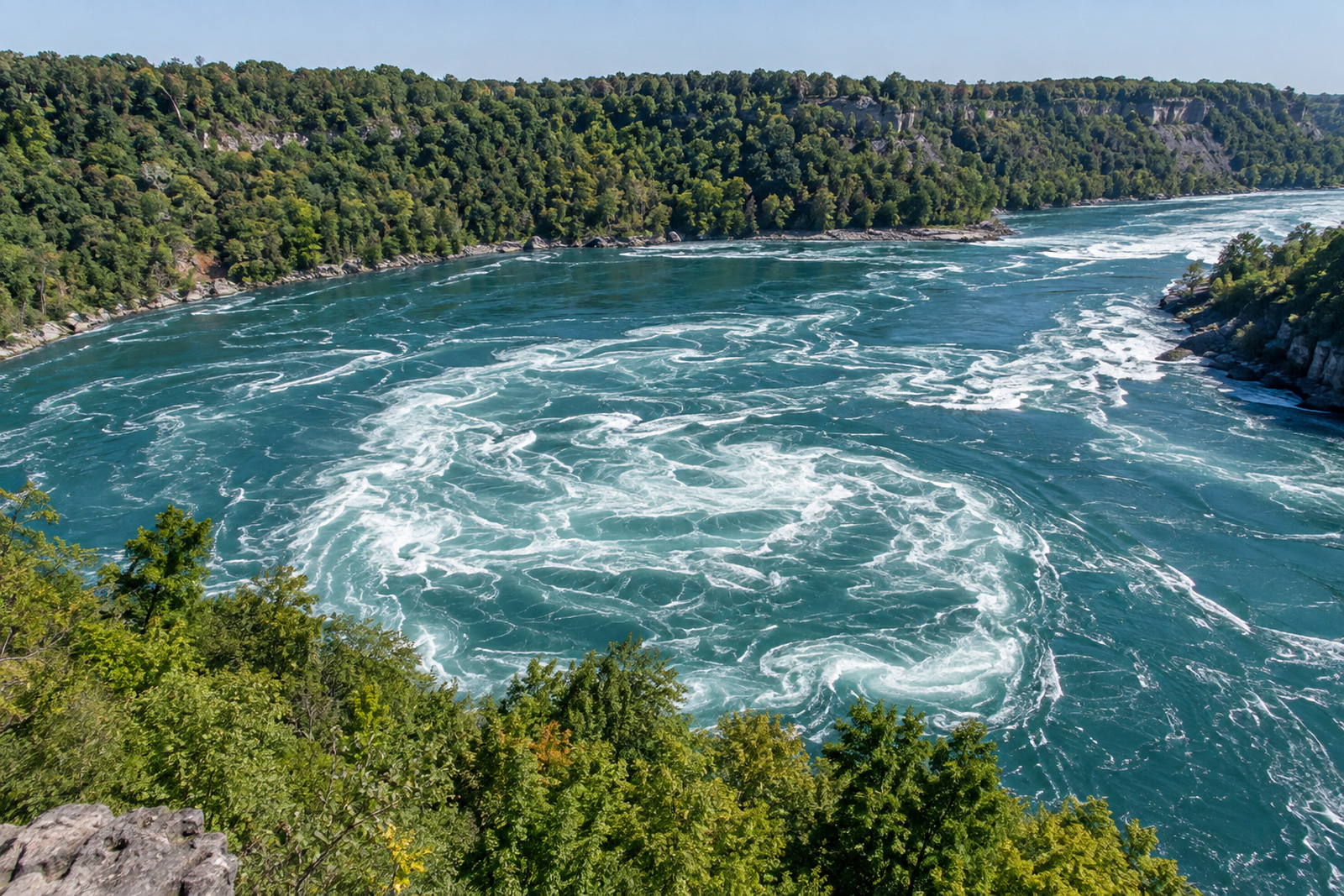
The direction of that spin is not fixed. Under normal conditions the Whirlpool turns counterclockwise. It reverses when a larger share of the river's flow is drawn off to the power stations upstream rather than left to run through the gorge. Riders who cross twice in a day, or return the following year, can watch the same body of water turn the opposite way, which is a strange thing to see from a cabin that has not itself changed in over a hundred years.
Four border crossings on one cable
The Aero Car runs on a single span, without a supporting tower in the gorge itself, which is part of why the crossing feels different from an ordinary cable car. The international boundary between Canada and the United States follows the river through this section, and the car's cable crosses it four times over the course of one trip, out over the gorge and back, on a line that curves rather than running straight bank to bank. Passengers do not need a passport for it; nothing at either tower checks status, and the whole ride stays inside park land on the Canadian side.
That is worth pointing out because most visitors think of the border here as something fixed to a bridge, checked by an officer in a booth. Above the Whirlpool it is just a line on a map, crossed and recrossed by a cabin full of tourists who never leave Canadian ground. The four crossings are a fact about geography, not about paperwork.
An engineer from Spain, and a machine that stayed put
Torres Quevedo's design reached the gorge with Spanish capital and Spanish operators. The first test run took place on 15 February 1916, and the car opened to the public that August. It stayed under Spanish ownership for decades before the Niagara Parks Commission bought it in 1968. The mechanism was rebuilt in 1984, but the cabin riders sit in today is the original one, kept rather than replaced.
That continuity is unusual for a piece of tourist infrastructure this old. Most attractions built in the same decade have been rebuilt from the ground up at least once, sometimes more. The Aero Car has had one major overhaul of its machinery in over a century of running, on the same cable route, over the same stretch of water. It is one of the few places at Niagara where the object in front of you is close to the object a visitor would have seen in 1916, not a modern reconstruction standing on an old footprint.
What you see from the cabin
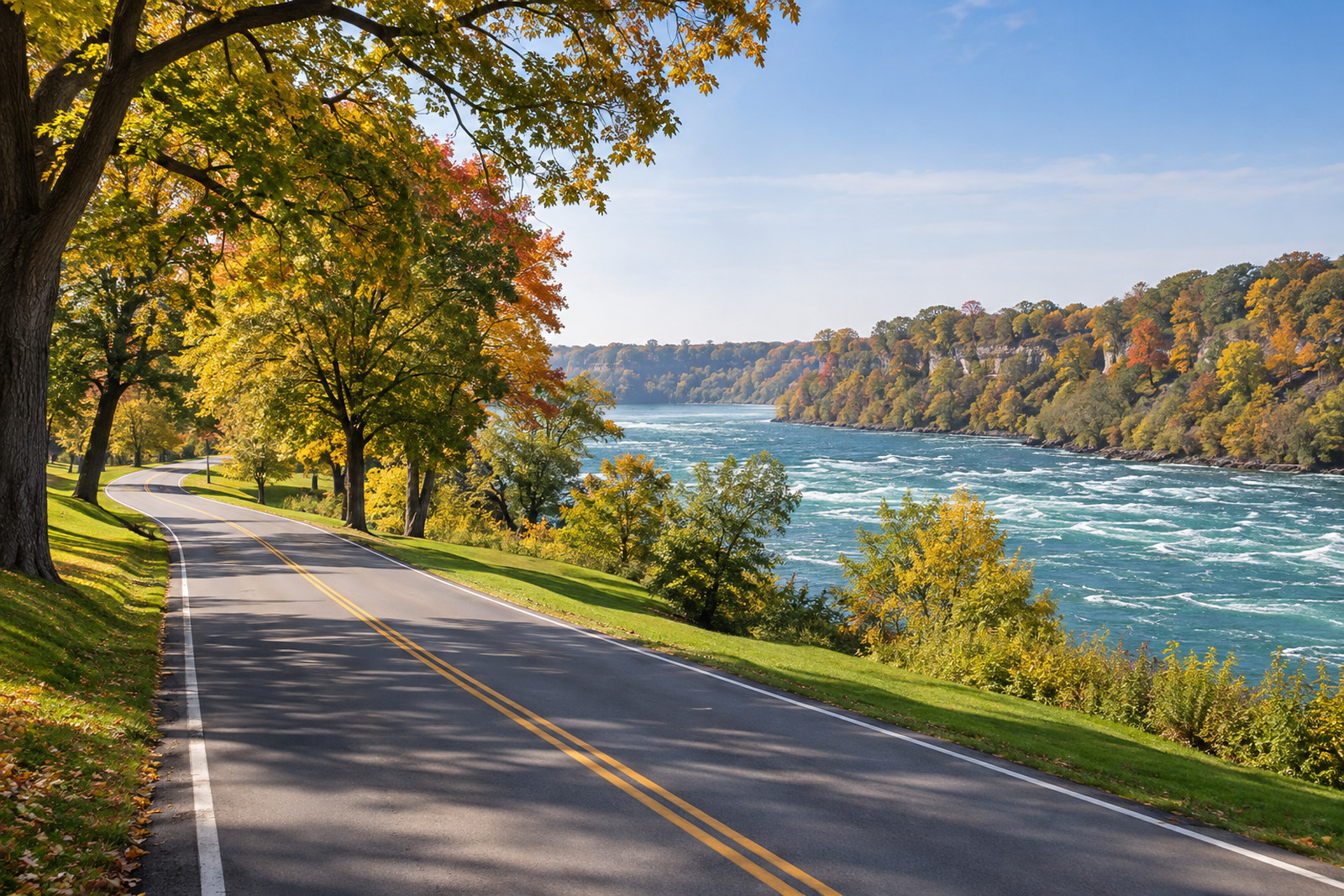
The ride runs at a fixed, unhurried pace that leaves time to look straight down. The water below does not run in one direction the way it does upstream at the rapids. Debris and foam can be seen circling, sometimes for a long stretch, before the current finally pulls them out toward Lewiston. The Whirlpool Aero Car station sits within Niagara Parks land, a short drive from the falls themselves along the route that follows the gorge north, away from the crowds gathered at the brink.
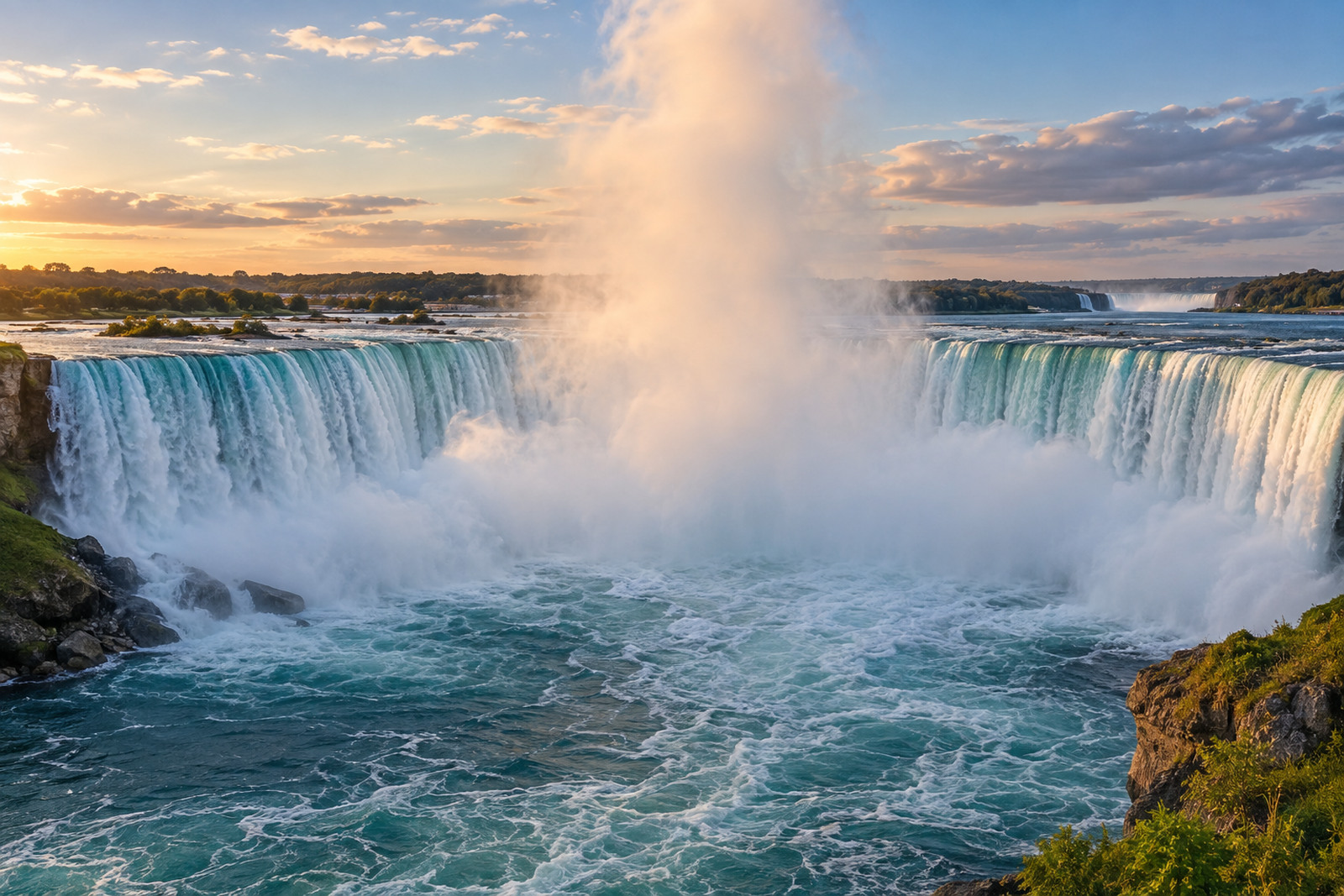
The falls themselves are the reason most people come to this stretch of the Niagara River, and the Aero Car does not compete with that view, nor try to. What it offers instead is a piece of the same river a few kilometres downstream, doing something the falls never do: circling in place, changing direction according to how much water the power stations are taking that day, and framed by a machine old enough to have watched most of that history happen underneath it.
A short detour worth the walk
For a visitor coming from the American side of the falls, or staying anywhere along the Niagara Parkway, the car is a short detour rather than a destination on its own. It rewards anyone curious about what the gorge looks like away from the crowds at the brink, and about a stretch of river shaped less by the falls than by what lies buried beneath it. There is no other point on the Niagara Parkway where a hundred-year-old Spanish machine and a four-thousand-year-old geological accident sit this close together.
Résumer cet article avec :
Partager :