

What You're Actually Looking At: Horseshoe Falls Versus American Falls
Contents3 sections
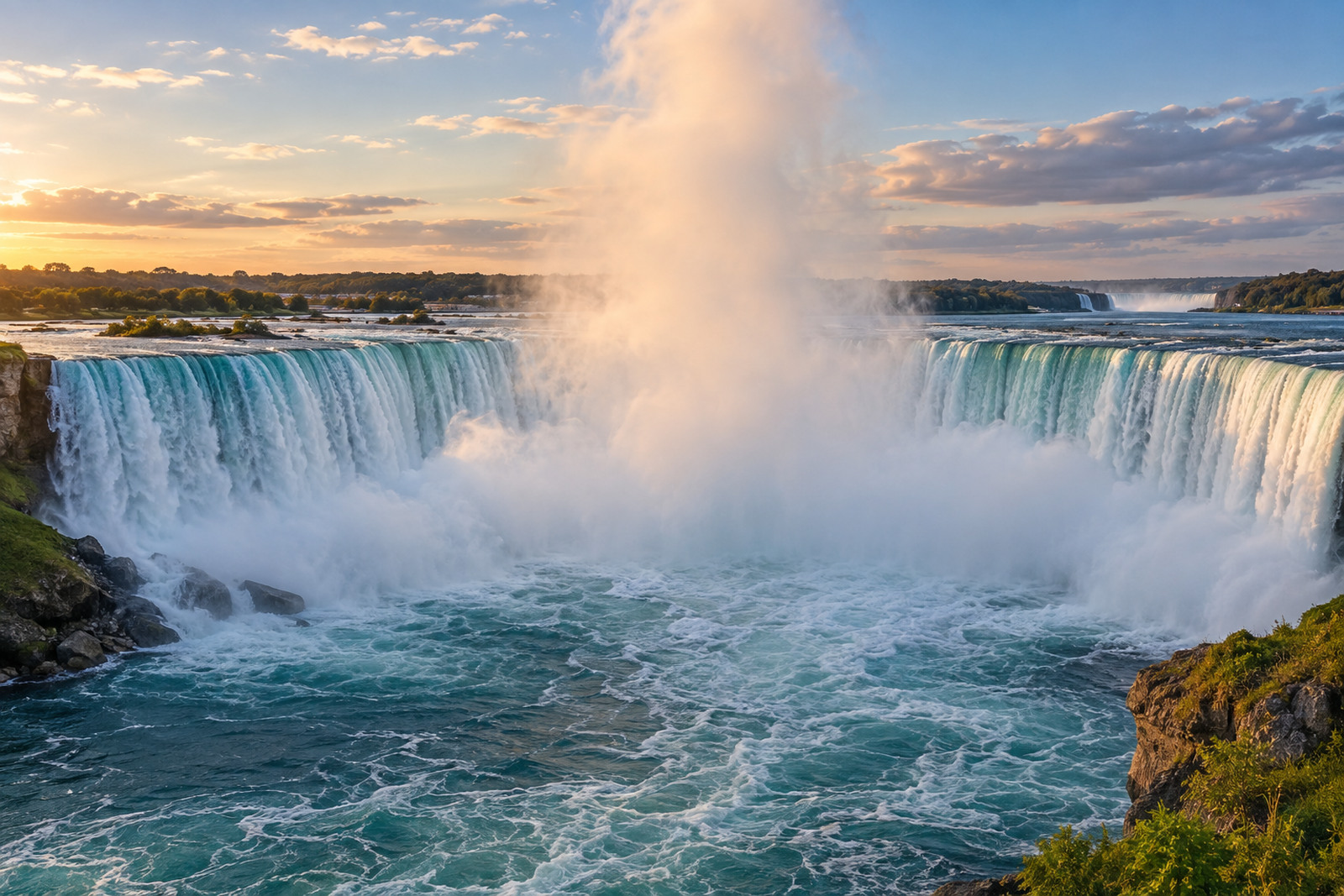
The Niagara River splits into two falls at Goat Island, and the split is far from equal. About ninety percent of the water goes over Horseshoe Falls, on the Canadian side. The rest, close to ten percent, spills over American Falls on the New York side. That single number decides most of what a visitor actually sees, and it rarely gets explained clearly on either bank.
A different figure gets repeated online next to Horseshoe Falls: sixty percent. It is a real number, but it belongs somewhere else. It describes how much of the river gets diverted into the Chippawa Channel, an upstream branch of the Niagara River, before the water ever reaches the brink of either fall. It has nothing to do with how the two falls share what arrives at the edge. Mixing up the two numbers is a common mistake in anything written about this stretch of river.
Total flow over both falls is fixed by treaty during the day in season, at 2,832 cubic metres per second. At night, and through the winter months, that minimum drops to half. Whatever the total, the roughly ninety-ten split between Horseshoe and American holds. Ninety percent of a large number, spread across a crest of about 700 metres, since the two agencies that measure it land between 670 and 790 metres, makes for a thick, continuous curtain of water. Ten percent of that same total, spread across a crest of 260 to 300 metres at American Falls, makes for something thinner and more broken.
The height that isn't there
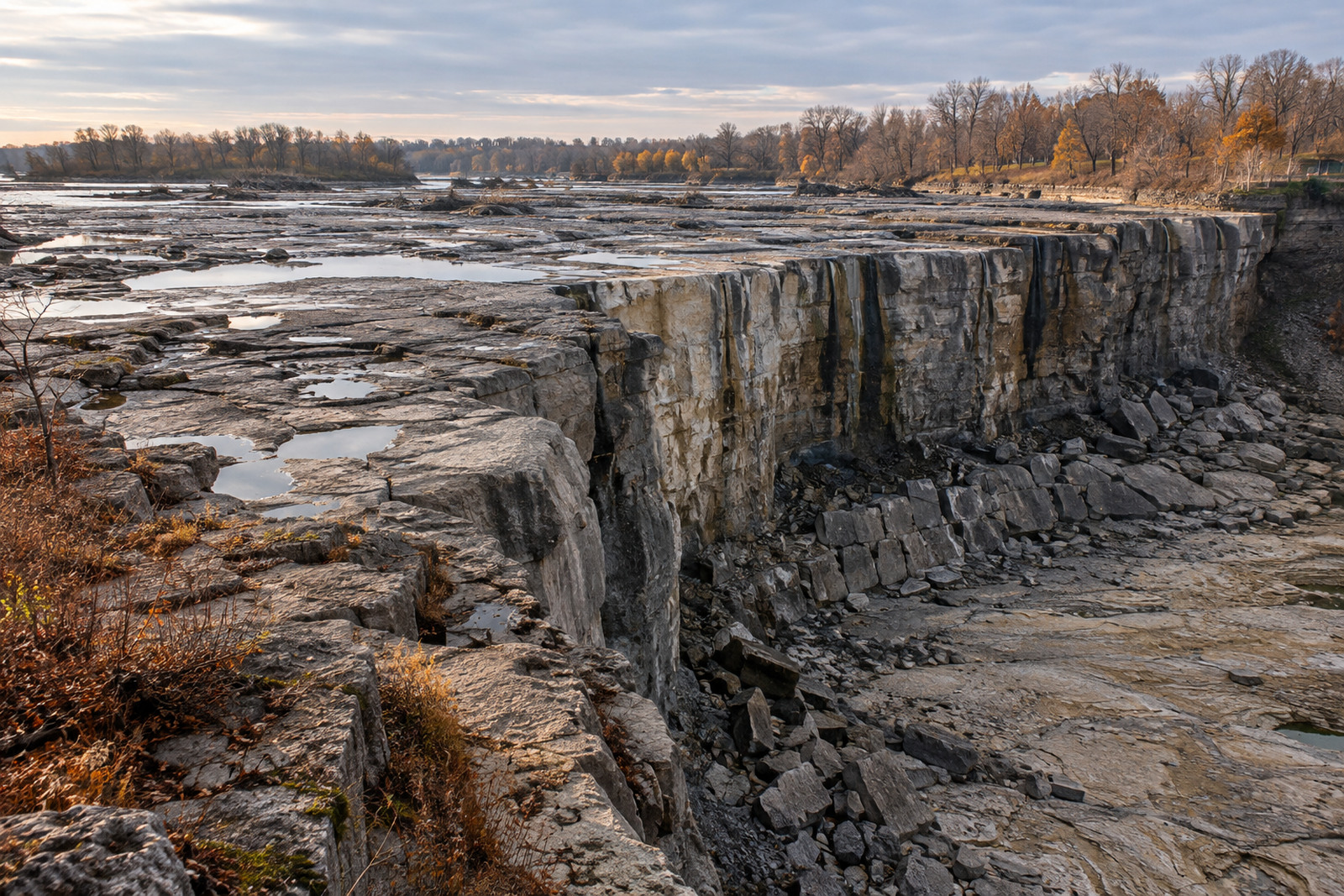
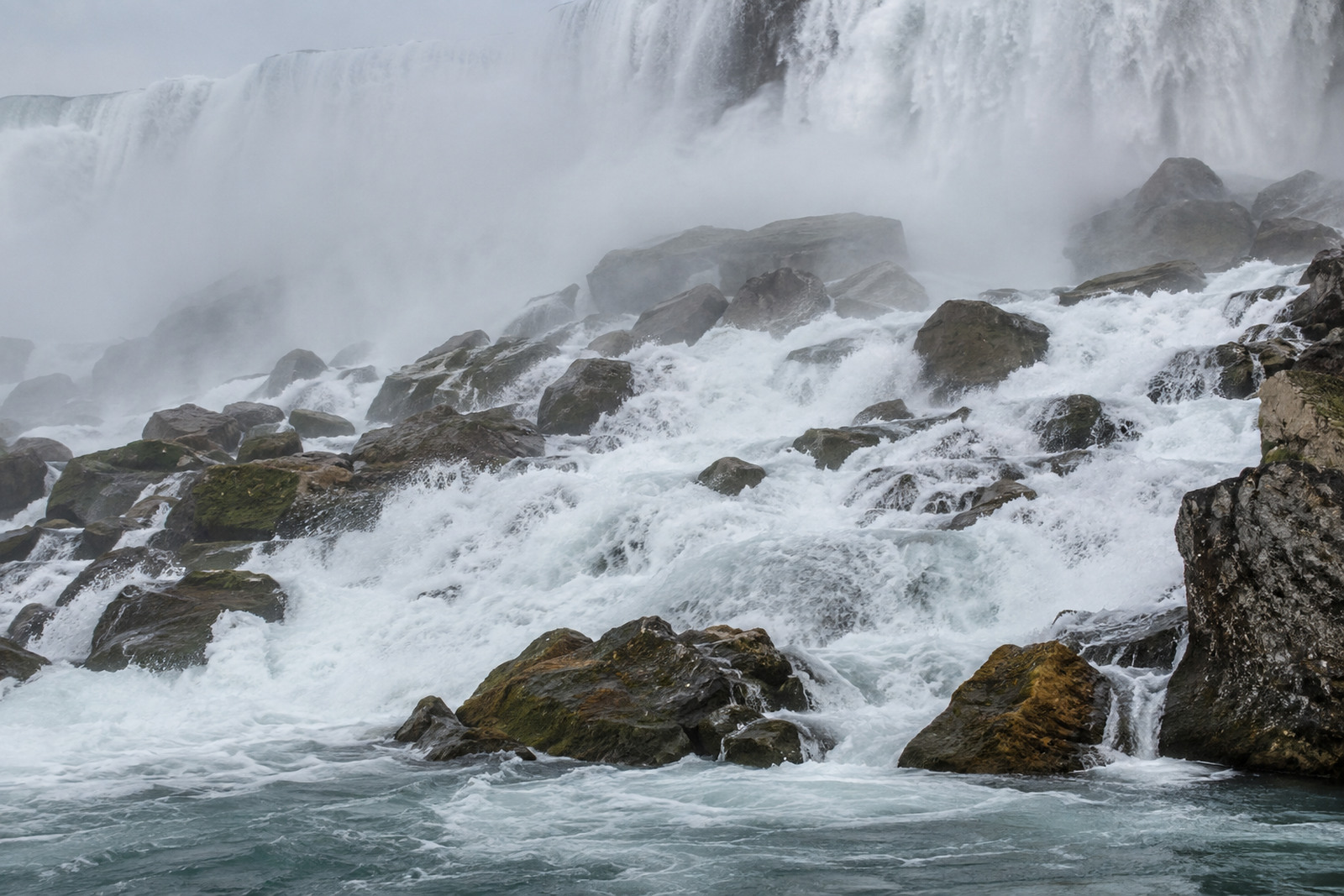
Horseshoe Falls drops about 57 metres, 188 feet. American Falls is usually listed at the same 188 feet, which makes the two sound identical in scale. They are not. The 188 feet at American Falls is measured down to the riverbed, and that riverbed is buried under a pile of fallen rock that has been building up at the base for well over a century. Strip that talus out of the measurement and the actual drop of falling water is somewhere between 21 and 34 metres, in places under half of what the posted number suggests.
That gap matters because American Falls photographs as a wide, dramatic drop from certain angles, and its number on paper matches Horseshoe's. Neither impression survives once you stand close to the base. The water column is thinner because it carries a tenth of the flow, and the visible fall is shorter because a slope of broken rock has quietly eaten a third or more of the drop.
What each bank actually puts in front of you
Stand on the Canadian side, near Table Rock, and you face Horseshoe Falls from across the basin, roughly in line with its curve. American Falls sits in the same field of view, off to the side, small enough that the two read as one scene. It is the closest thing to seeing the whole river's exit in a single glance.
Stand on the American side, on Goat Island or at Prospect Point, and the relationship flips. You are close to American Falls, sometimes almost above it, but you're looking along its short crest rather than facing it, and Horseshoe Falls sits at a distance, angled away rather than presented head on. You get proximity to the smaller fall and a wide, mostly rear-angled view of the larger one.
A lot of writing about Niagara claims the Canadian side gives the better view because Horseshoe Falls is curved, as though a curved shoreline naturally frames a photograph. No official source actually makes that argument. What can be said without stretching the facts is simpler: the Canadian bank puts you facing Horseshoe Falls directly, with American Falls visible in the same frame, and that combination doesn't exist from the American side.
Reading the falls instead of the numbers
Neither bank is the wrong choice, but they answer different questions. If seeing both falls together, in one continuous view, matters more than anything else, the Canadian side delivers that and nothing on the American side replaces it. If standing close enough to feel the spray, right at the edge of a drop, matters more, American Falls and Goat Island give that in a way Horseshoe's basin, seen from across the water, cannot.
Once that number is set aside, American Falls reads for what it actually is: a narrower, ten-percent share of the river, with a drop shortened by a century of accumulated rock, rather than a smaller twin of Horseshoe Falls.
Résumer cet article avec :
Partager :